Local Search Ranking Factors 2026: What Actually Moves the Needle
A current, data-driven breakdown of the local search ranking factors that matter in 2026 — Google Business Profile signals, reviews, citations, proximity, and on-page — based on ongoing analysis of real local rankings, not a recycled 2020 survey.

For years, the local SEO industry leaned on a handful of ranking-factor surveys to decide where to spend effort. The most cited of them — a 2020 analysis that rounded up expert opinion on what drives local results — is now offline. And honestly, a lot of its advice had already aged out before it disappeared.
Google Business Profile has absorbed far more ranking weight. Citations have continued their long slide toward irrelevance. And AI-driven search has changed how local intent gets answered at the surface.
So this is the replacement. Instead of a once-a-year opinion survey, it draws on continuous measurement — VeloRank's Geo-Grid™ tracking scans up to 169 map points per keyword, and our LocalLift™ engine scores 50+ on-page and profile factors for real businesses. What follows is what the data actually shows moves rankings in 2026, ordered by observed impact.
Each factor is rated by observed impact on the local pack and local organic results: Critical (table stakes — you won't rank without it), High (reliably separates winners from the middle), Medium (helps, situational), and Low (diminishing returns in 2026).
The 7 factor categories, ranked by 2026 impact
Here's the headline view before we break each one down. The biggest shift since the old 2020 survey: Google Business Profile and review signals now dominate, while citations — once a top-three factor — have fallen to a supporting role.
| Factor category | 2026 impact | Trend vs. 2020 |
|---|---|---|
| Google Business Profile signals | Critical | ↑ Growing |
| Review signals | Critical | ↑ Growing |
| Proximity & geo position | High | → Stable |
| On-page & website signals | High | → Stable |
| Links & authority | Medium | → Stable |
| Behavioral & AI-era signals | Medium | ↑ Emerging |
| Citations | Low | ↓ Declining |
Roughly, GBP and reviews together account for about half of what separates the top of the pack from everyone else. That's directional, based on LocalLift™ factor scoring correlated against Geo-Grid™ rank changes — but the ordering is consistent across the businesses we track.
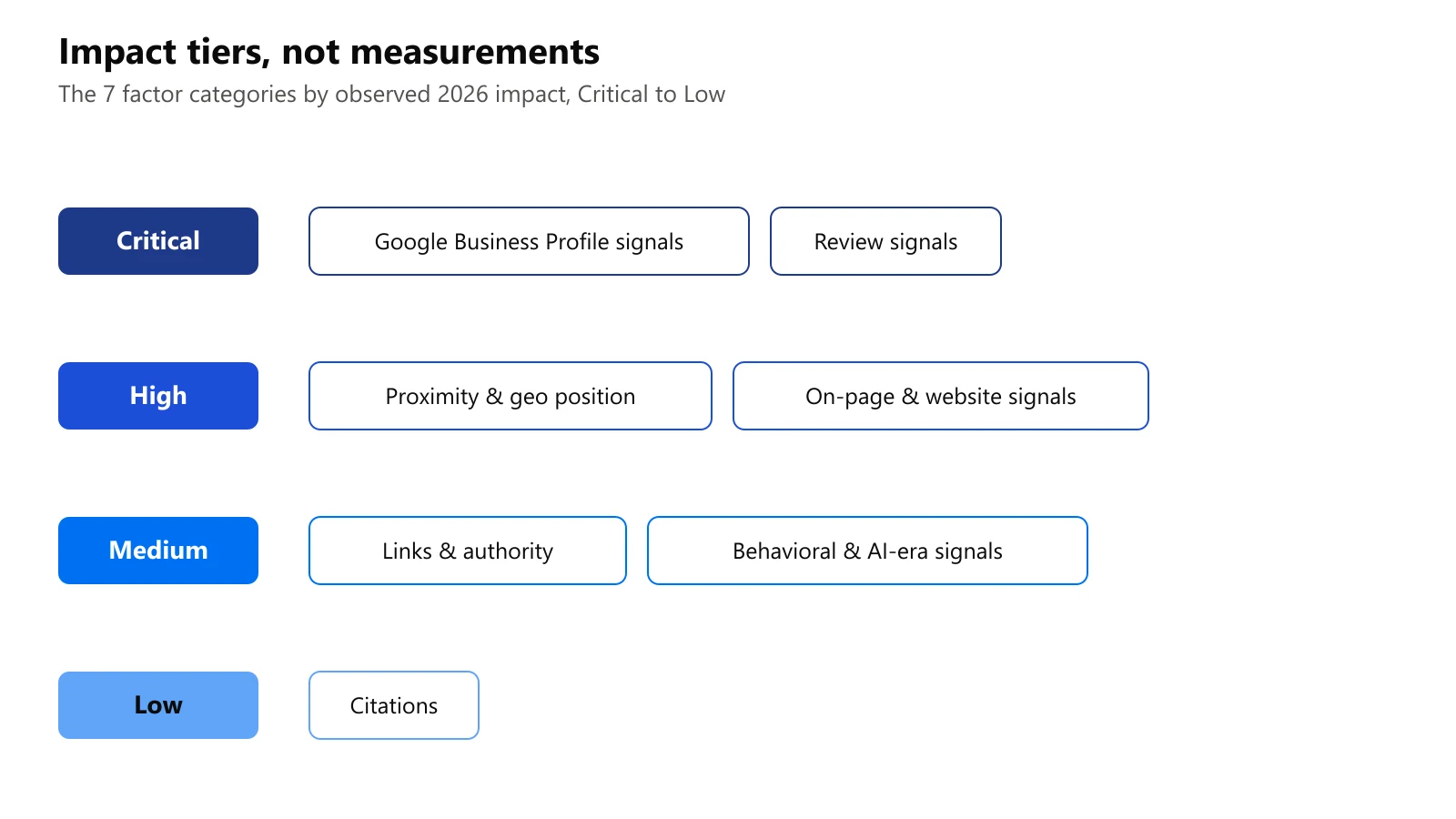
Impact tiers, not measurements. Critical: Google Business Profile signals, Review signals. High: Proximity & geo position, On-page & website signals. Medium: Links & authority, Behavioral & AI-era signals. Low: Citations.
1. Google Business Profile signals (Critical)
Your Google Business Profile is the single largest controllable input to local rankings. In our data, businesses with a fully-optimized GBP outrank otherwise-identical competitors across the majority of grid points. The sub-factors that matter most, in order:
- Primary category. The single strongest GBP lever. Choose the category that matches your #1 money keyword, not the broadest one.
- Business name. Real-world name only — keyword-stuffed names still rank short-term but are the top spam-report trigger and a suspension risk.
- Secondary categories. Each one is an eligibility ticket for another set of queries. Add every category that genuinely applies.
- Services & products. Fully populated service items reinforce category relevance and feed AI-generated local answers.
- Completeness & freshness. Hours, attributes, photos, and regular Posts signal an active, trustworthy listing.
GBP fields increasingly feed AI Overviews and voice answers, not just the map pack. A complete profile is now also your structured data for AI local search.
2. Review signals (Critical)
Reviews are the fastest-moving lever most small businesses underuse. Three dimensions matter:
- Quantity & velocity. A steady stream of new reviews beats a one-time burst. Recency is a ranking input.
- Rating & keywords. High average rating matters, but so does the language — reviews that naturally mention your service and city reinforce relevance.
- Responses. Owner responses correlate with better pack placement and higher click-through.
Don't overlook reviews on third-party directories (Yelp, Facebook, industry sites). Prominence on those platforms lifts your listing's authority there and feeds the broader prominence signal Google reads.
3. Proximity & the geo-grid reality (High)
Proximity to the searcher remains a top factor — and it's the one you can't optimize away. What you can do is understand exactly where you win and where you don't. That's why we built Geo-Grid™ tracking: a single "rank #3" average hides the reality that you might rank #1 within a mile and #12 across town.
- You can't move your pin, but you can expand the radius where you're competitive by strengthening every other factor on this page.
- Service-area businesses should not expect to rank in the pack far outside their verified city — set realistic geo targets.
- Additional locations (legitimately staffed) are the only real way to widen pack coverage.
4. On-page & website signals (High)
Your website still feeds local rankings — both directly (local organic) and indirectly (it reinforces your GBP's relevance).
- A dedicated page per service + location you want to rank for. One generic "services" page can't rank for everything.
- Title tags & H1s with the service + city, written for humans.
- LocalBusiness schema with consistent NAP, geo, and sameAs — use our free schema generator to ship it cleanly. This one's an easy separation play: 87.7% of Minnesota businesses don't have it.
- Page speed & mobile. Slow, broken mobile pages suppress both organic and pack performance. This is table stakes in 2026.
- Embedded map + consistent NAP in the footer and contact page.
5. Citations — the long decline (Low)
Citations were a top-three factor a decade ago. In 2026 they're a foundational hygiene signal, not a growth lever. Mass citation building hits diminishing returns fast. What a healthy citation profile looks like now:
- The core listings: Google, Apple Maps, Bing, Facebook, Yelp.
- The major data aggregators that feed the ecosystem.
- Every industry-specific directory for your category.
- Every city/state-specific directory for your location.
- A handful of top general directories — then stop.
Getting reviews on the niche directories you do claim. Prominence there can push you to the top of that site's category page — a listing that passes real authority and relevant content. Most businesses skip this.
6. Links & authority (Medium)
Links matter less for the local pack than for organic, but authoritative, locally-relevant links still move both. Quality beats quantity: a link from a local news outlet, a chamber, or a respected industry resource outweighs dozens of directory links.
(It's also why keeping the web's links working matters — a dead resource with live backlinks is an opportunity for whoever builds the replacement. Which, not coincidentally, is exactly how this page came to exist.)
7. Behavioral & AI-era signals (Medium)
The newest category — and the one the old 2020 survey couldn't have anticipated.
- Click-through & engagement on your listing (calls, direction requests, website taps) feed prominence.
- AI Overviews & voice. Local intent is increasingly answered by AI that reads your GBP, reviews, and structured data. Clean, complete, consistent data is how you get recommended.
- Brand searches. People searching your name directly is a durable authority signal.
Local SEO myth-busting
Pros
- Nail your primary GBP category and add every relevant secondary category
- Build a steady, compliant stream of new Google reviews — and respond to all of them
- Complete every GBP field; it's now your structured data for AI local answers
- Ship a dedicated page for each service + location, with LocalBusiness schema
- Track rank movement across a geo-grid, not a single average position
Cons
- "More citations = higher rank." False in 2026 — beyond the core + niche set, returns collapse.
- "Keyword-stuff your business name." Short-term gain, high suspension risk.
- "Rank anywhere with a virtual office." Google's onto it; fake locations get suspended.
- "Set it and forget it." Local rankings decay — reviews, posts, and freshness are ongoing inputs.
- "AI will replace local SEO." It changes the surface, not the signals. Clean data wins in both.
Your 2026 local SEO to-do list
- 1
Nail your primary GBP category and add every relevant secondary category. This is the highest-leverage single change most businesses can make.
- 2
Build a review engine — a steady, compliant stream of new Google reviews, plus responses to all of them. Velocity and recency count.
- 3
Map your real coverage with a geo-grid scan so you know where you actually win, instead of trusting one average position.
- 4
Ship a dedicated page for each service + location, with LocalBusiness schema and consistent NAP.
- 5
Clean up core citations (Google, Apple, Bing, Facebook, Yelp + your niche) — then stop building mass citations.
- 6
Complete every GBP field — hours, attributes, services, photos. It's now your structured data for AI local answers.
- 7
Track rank movement against the factors above, not a single average position. The free SEO scorecard grades your site on the biggest ones in about a minute.
Find a starting point with our free SEO tools, or request an expert local SEO audit.
The bottom line
The signals that decide local rankings in 2026 aren't mysterious — they're just different from what a five-year-old survey says. Google Business Profile and reviews carry the most weight, proximity sets your ceiling, your website and links support the whole thing, and citations have settled into a hygiene task you finish and move on from.
The businesses that win the local pack aren't doing anything exotic. They're doing the Critical factors completely, the High factors well, and they're measuring the result across their real service area instead of guessing. That's the whole game.

AI Overviews and Local Search: What Actually Gets Cited (and How to Be the Citation)
VeloRank ran its own AI-citation probe on real Minnesota hiring questions. 68.3% of cited sources were directories, not the business (n=41 sources, 11 queries). Here's who got cited, and why.
Read the story ↗
Best Local SEO Rank Trackers: Full Guide
Discover the best local SEO rank tracker tools, free local SEO audit options, and automation software to dominate Google Maps rankings.
Read the story ↗
Google AI Mode and Local Search: 7 Moves for Minnesota Businesses in 2026
Google AI Mode is reshaping local search in Minnesota. Discover the AI mode SEO tools, rank tracking, and 7 moves your business needs to win all three results.
Read the story ↗A little direction goes a long way
Put these ideas to work.
Talk with our team about improving your website and local search visibility.