Minnesota Local SEO Statistics 2026: We Analyzed 1,058 Small-Business Websites
Original research: we crawled 1,058 Minnesota chamber-member business websites and probed how AI assistants recommend local businesses. 87.7% have no LocalBusiness schema, 74% fail mobile performance, and most AI citations go to directories — not businesses.

Most local SEO statistics you'll find are recycled national numbers from five years ago. So we built our own dataset.
In August 2026, we analyzed 1,058 Minnesota small-business websites — every member business listed in three Minnesota chamber-of-commerce directories — and then asked a second question almost nobody is measuring yet: when an AI assistant recommends a local business, whose website does it actually cite?
The short version: Minnesota's small businesses are in Google, but they're not in the answer. Here's the data.
Every statistic on this page comes from data we collected ourselves, with the method stated inline and in the methodology section below. If you cite a number, please link back to this page as the source — and check the "last updated" date above, because we re-run this research as the data ages.
The headline numbers
| Finding | Number | Sample |
|---|---|---|
| Business websites with no LocalBusiness schema | 87.7% | 922 live sites |
| Sites scoring "poor" on mobile performance (Lighthouse < 50) | 74% | 94-site sample |
| Unique cited sources that were directories, not the business | 68.3% | 41 unique sources, 11 grounded queries |
| Member websites that are dead or unreachable | 12.9% | 1,058 sites |
| Live sites with no visible phone number | 41.3% | 922 live sites |
| Chamber directory links that are broken | 9.1% | 3,258 links |
1 in 8 member websites is simply gone
Of the 1,058 member businesses listed in the three chamber directories, 12.9% had websites that were dead or unreachable — domains that no longer resolve, homepages returning errors, sites that have quietly disappeared while the listing lives on.
Related: 9.1% of the 3,258 outbound links in those chamber directories point at dead or broken destinations. Directory rot is real, it's measurable, and it silently strands customers every day. (If the web's overall decay is your interest, Pew Research found 38% of pages from 2013 were gone by 2023 — local business sites appear to churn even faster.)
87.7% are invisible to structured search — and to AI
This is the number that should worry every Minnesota business owner.
Of the 922 live websites we analyzed:
- 87.7% have no LocalBusiness structured data — the machine-readable block that tells Google (and increasingly, AI assistants) what the business is, where it is, and how to reach it.
- 34.4% have no JSON-LD structured data of any kind.
- 30.5% have no meta description, and 30.8% have a title tag under 30 characters — often just the business name.
- 27.7% don't have a single H1 heading.
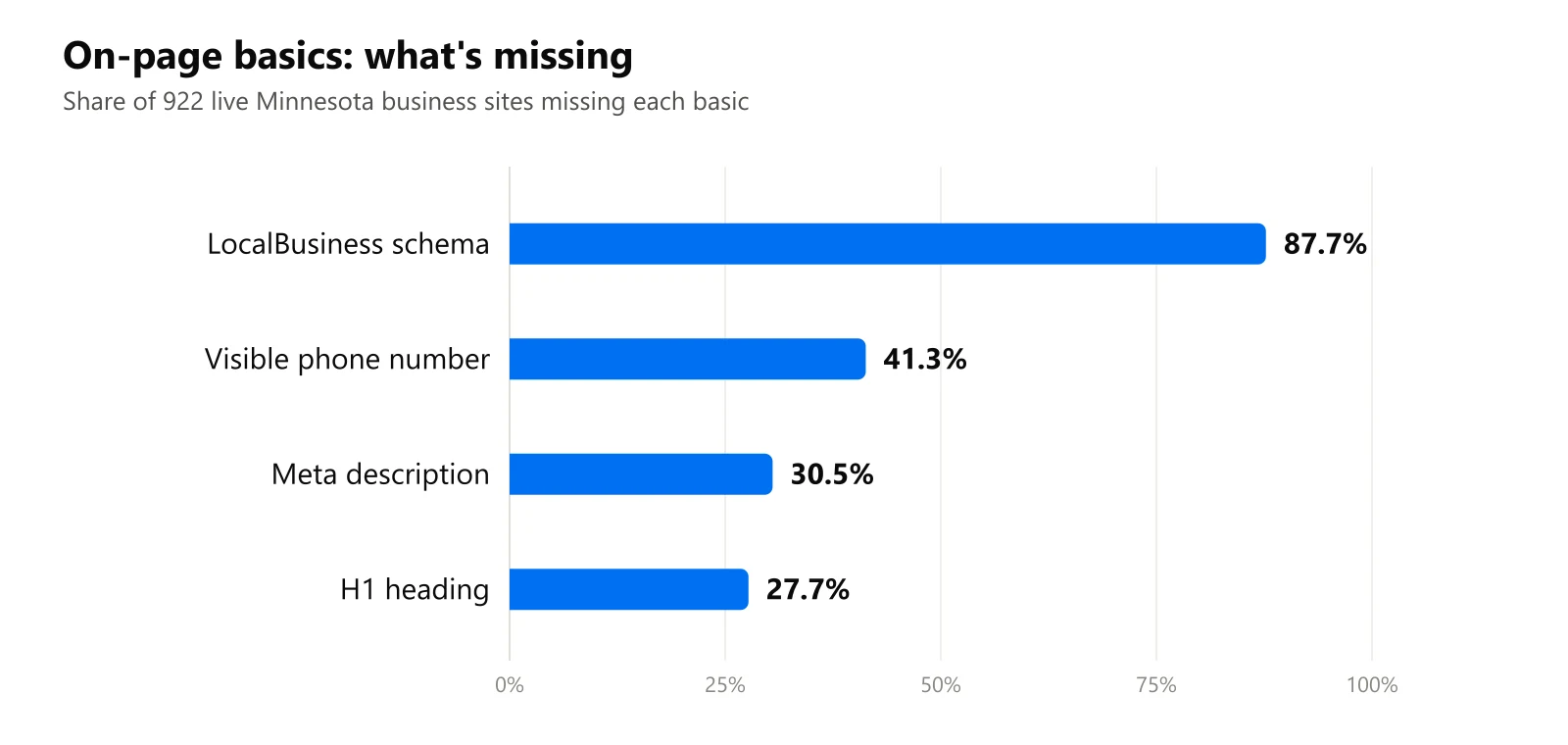
87.7% of live sites have no LocalBusiness schema, 41.3% have no visible phone number, 30.5% have no meta description, and 27.7% have no H1 heading. n = 922 live sites.
None of this is exotic optimization. It's the basic markup layer that search engines and AI systems read before deciding who to show. Which connects directly to the next finding.
For a decade, missing schema meant slightly worse snippets. In 2026, GBP fields and on-site structured data feed AI Overviews and assistant answers directly. A site without structured data isn't just harder to rank — it's harder for the answer layer to quote.
When AI recommends a local business, it usually cites everyone but the business
This is the measurement almost nobody is doing yet. We asked a live, web-grounded frontier model (via API) the questions real customers ask — "Who is the best plumber in Eagan, Minnesota?", "Best HVAC repair company in Rosemount MN", "Who should I call for tree removal in Apple Valley?" — and analyzed every source the AI cited in its answers.
Across 11 local hiring questions and 41 unique cited sources:
- 68.3% of those unique sources were third-party directories and platforms — BBB, Expertise.com, Angi, HomeAdvisor, booking platforms, Reddit.
- Only 24.4% were a recommended business's own website. (The remaining 7.3%: manufacturer and other sites.)
Put plainly: the AI answered "who should I hire," and more than two-thirds of the sources it leaned on weren't the businesses at all. The businesses that did get cited directly had one thing in common — websites with enough real, readable content about their service and location for the AI to ground on.
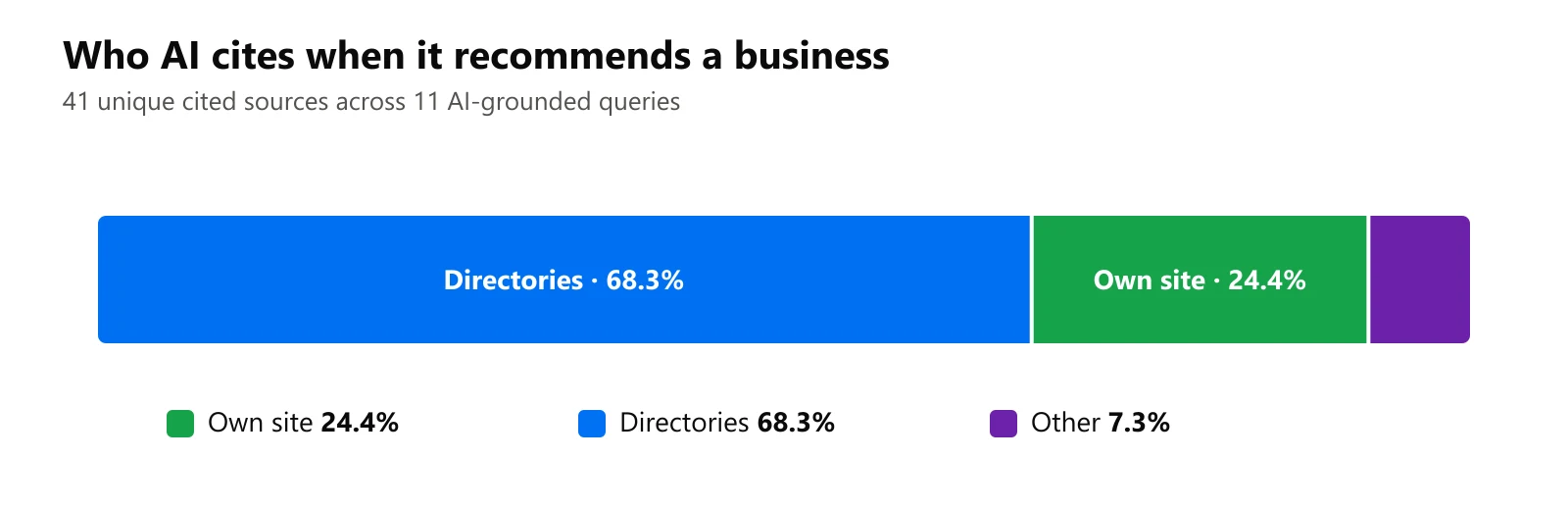
68.3% directories, 24.4% own site, 7.3% other. n = 41 unique cited sources across 11 AI-grounded queries; counting unit = unique normalized sources per response.
AI leans on directories because most business sites (87.7%, see above) give it nothing structured to read. Every business that fixes its markup and content earns a shot at being the citation — while everyone else's customer journey routes through a middleman with an ad model.
For the query-by-query breakdown across nine industries, see our industry-by-industry look at Minnesota local SEO.
The mobile performance picture is worse than the SEO picture
We ran Google Lighthouse mobile audits across a random 94-site sample of the same population:
- Median mobile performance score: 35 / 100.
- 74% scored under 50 — Google's "poor" band.
- Only 7.2% of the full population lacked a mobile viewport tag — so these are "mobile-friendly" sites in the 2015 sense that are slow in the 2026 sense.
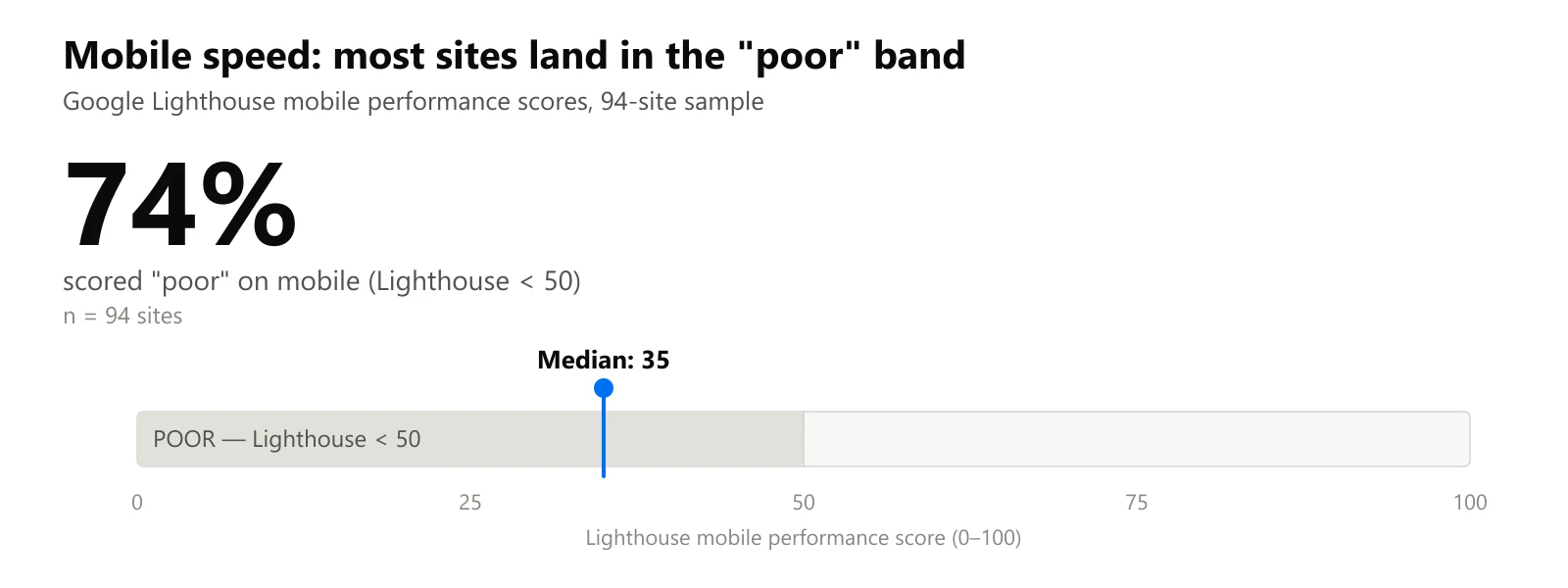
Median mobile performance score: 35 out of 100. 74% scored below 50, Google's "poor" band. n = 94 sites.
Page speed is a confirmed ranking input and a brutal conversion input. A median score of 35 means the typical Minnesota business website loses mobile visitors before it finishes loading.
The twist: these businesses aren't invisible in Google — they're unchosen
Here's the finding that surprised us, and we're reporting it straight because it cuts against the easy narrative.
Using ranking data for a random 138-site sample of the population:
- 0% ranked for zero keywords. Essentially every established business ranks for something.
- Only 7% ranked for fewer than 10 keywords.
- The median site ranked for 707 keywords — mostly brand terms and incidental long-tail phrases, counted anywhere in the top 100.
So "small businesses are invisible in search" is a myth — at least for established, chamber-member businesses. The real problem is sharper: they're indexed but not chosen. Showing up at position 40 for 707 scattered phrases wins nothing. The layers that decide who actually gets the call — the local pack, the top 3, and now the AI answer — run on exactly the signals this study shows are missing: structured data (87.7% lack it), performance (74% poor), and a citable, readable site. For the full breakdown of which factors actually move local rankings in 2026, we maintain a companion analysis based on continuous rank measurement.
What this means if you run a Minnesota business
- 1
Check whether you're in the 87.7%. View your homepage source and search for "LocalBusiness". If it's not there, adding schema is hours of work with an outsized payoff in the AI era. Our free schema generator does it.
- 2
Search yourself the way AI does. Ask an AI assistant "best [your service] in [your city]" and see who gets cited. If the answer routes through Angi or BBB instead of you, that's your gap — and your competitors' gap too, which means it's still winnable.
- 3
Take the mobile score seriously. Run PageSpeed Insights on your phone URL. If you're under 50, you're in the 74% — and speed is one of the few factors where fixing it helps rankings, conversions, and AI citability at once.
- 4
Make the basics machine-readable. Visible phone number (41.3% don't have one), real title tag, meta description, one H1. This is the floor, and a third of your local competitors aren't on it.
Grade your website with the free SEO scorecard. Minnesota businesses that want this handled end-to-end can see how we help you get found first.
Methodology
Population. All member businesses listed in the online directories of three Minnesota chambers of commerce (a regional metro chamber, a statewide chamber, and a county regional chamber), collected August 2026. After excluding national brands, institutions, government/education entries, and non-website links (newsletters, documents, social profiles): 1,058 unique business websites.
On-page factors (n = 1,058). We fetched each site's homepage directly (standard desktop browser user-agent, following redirects) and parsed the served HTML for: reachability, HTTPS, JSON-LD presence, LocalBusiness-family schema types, title tag and length, meta description, mobile viewport tag, H1 presence, and a visible phone number pattern. Sites unreachable after retries were classed dead/unreachable (12.9%).
Directory link rot (n = 3,258). Every outbound link in the three directories was probed and classified (HTTP 404/410, soft-404 by content analysis, connection/DNS failure). 9.1% were dead or broken.
Mobile performance (n = 94). Google Lighthouse mobile audits (performance + SEO categories) via the DataForSEO API on a random 100-site sample of live sites; 94 returned complete scores.
Rankings (n = 138). Ranked-keyword totals (any position ≤ 100, US Google) via DataForSEO Labs on a random 150-site sample; 138 returned data.
AI citations (n = 11 queries, 41 unique cited sources). Live, web-grounded queries to a frontier model (GPT-5.5 with web search, via the DataForSEO AI Optimization API) using natural local hiring questions across Minnesota cities and service categories. We count unique cited sources per response — repeated inline citations of the same URL count once. The original 6 queries (plumber, HVAC repair, landscaping, butcher shop, tree removal, hair salon) were re-classified under the same rules for this update, and we added 5 new queries using a shared template, "Who is the best {trade} in {city}, Minnesota?": roofing company in Lakeville, dentist in Apple Valley, real estate agent in Rosemount, handyman in Eagan, and general contractor in Burnsville. Every unique source was classified as the business's own site, a third-party directory/platform, or other (mainly manufacturer sites). We label this a probe, not a survey: the sample is still small and we'll keep expanding it in future updates.
Limitations, stated plainly. This is a single-state population of chamber-member businesses — established enough to pay dues, which likely makes these numbers better than the true small-business average. Ranked-keyword totals count any top-100 position and therefore overstate meaningful visibility. The AI-citation probe is directional, and one classification call in it is a judgment call worth flagging: a Great Clips corporate location page was counted as the business's own site rather than a directory listing; classifying it the other way would put the directory share at 70.7% instead of 68.3%. We prefer honest, small, well-defined samples over impressive vague ones; we'll grow the dataset in future revisions.
Cite this research
Referencing these statistics? Link to this page as the source. For questions about the data or methodology, contact us. This page is updated as we re-run the research — the date at the top reflects the most recent revision.

AI Overviews and Local Search: What Actually Gets Cited (and How to Be the Citation)
VeloRank ran its own AI-citation probe on real Minnesota hiring questions. 68.3% of cited sources were directories, not the business (n=41 sources, 11 queries). Here's who got cited, and why.
Read the story ↗
Best Local SEO Rank Trackers: Full Guide
Discover the best local SEO rank tracker tools, free local SEO audit options, and automation software to dominate Google Maps rankings.
Read the story ↗
Generative Engine Optimization (GEO) Tools for Local Businesses: 2026 Comparison
A criteria-first comparison of real GEO and AEO tools, including Profound, Otterly, Peec AI, Ahrefs Brand Radar, and Semrush, plus VeloRank's free checker, positioned honestly.
Read the story ↗A little direction goes a long way
Put these ideas to work.
Talk with our team about improving your website and local search visibility.